Background
What follows here is Camino de Santiago background information, much of which I posted in the blog for my walk on the Camino in April 2016. That blog can be seen on this site by clicking on the plus sign in the top left, then at the bottom selecting “Archives” and then “Camino 2016” in the Categories list. If you read that blog, you will find this to be the same general information, slightly updated. (In re-reading it myself, I find it interesting.)
Description and Some History of the Camino de Santiago
Through history, three important pilgrimages for Christians evolved:
- The first led to tomb of St. Peter in Rome, travelers to Rome were called wanderers, and took the cross as their symbol.
- The second led to the Holy Sepulcher of Christ in Jerusalem; those who took this road were called palmists, since they had as their symbol the palm branches with which Jesus was greeted when he entered the city.
- The third led to the remains of the apostle San Tiago: St. James in English, Jacques in French, Giacomo in Italian, Jacob in Latin. He was buried on the Iberian peninsula where, one night, a shepherd had seen a brilliant star above a field. The site became known as Compostela – the star field – and a city arose drawing travelers from every part of the Christian world, and a cathedral was built. These travelers were called pilgrims, and their symbol was the scallop shell. Scallops are plentiful in the Bay of Biscay just north of this part of Spain, and when drawn on a map, the the many routes of the Camino de Santiago all ending at Santiago de Compostela appear much like the lines on a scallop shell.
The Camino de Santiago, also known as the Way of Saint James, is a centuries-old Christian pilgrimage route through France and Spain, ending at the cathedral in Santiago de Compostela, where the remains of St. James are enshrined. People have been making their way to Santiago for more than a thousand years. In past times, the motivation for the pilgrimage varied, as it does today. It was believed that sins would be forgiven at the end of a pilgrimage, or sometimes the pilgrimage was made as a penance.
There are many long distance footpaths, but only the Camino de Santiago has won the recognition of the United Nations and has been given World Heritage status on account of its historical and spiritual significance. The Camino’s ability to transform and elevate human consciousness remains undiminished over centuries.
There are many routes to Santiago de Compostela. In medieval times, a pilgrim started at their house. I will start my walk at the southwestern French town of Saint Jean Pied de Port, a town where a few routes come together and what has evolved to be a very common starting point. From Saint Jean Pied de Port I shall walk 800 kilometers (500 miles) to Santiago de Compostela on the route known as the Camino Frances. One could start in Lisbon, Portugal and travel north on a route known as the Camino Portugese. Or start in Madrid and walk westward across Spain on the Camino de Madrid, joining the Camino Frances at Leon, or for a much longer walk, start in Paris at the Notre Dame and walk south to join the Camino Frances across northern Spain to Santiago de Compostela. And there are several other routes.
In recent years, the Camino de Santiago has seen a growth in popularity. In 2013, more than 215,000 pilgrims received compostelas, the certification of completion, in the Pilgrims Office in Santiago. One can receive a compostela if they can show that they walked at least 100 km (62.5 miles). Of those 215,000, about 152,000 walked the Camino Frances, and 52,000 of those started at Sarria, and walked only the last 110 km. About 26,500 pilgrims started in St. Jean Pied de Port in 2013. By far the majority in the summer months of June, July, and August.
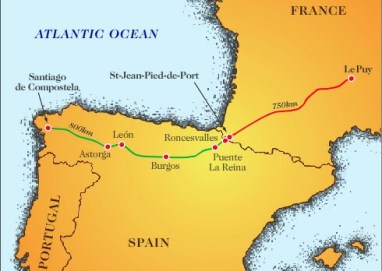
Here is a map of the route I’ll be walking, the Camino Frances, shown as the green line, starting at St. Jean Pied de Port in southwestern France, going into Spain and through Puenta La Riena, Pamplona (famous for the running with the bulls), Burgos, Leon, Astorga, and finally to Santiago de Compostela. The red line is another 750 kilometer (465 miles) segment known as the Camino Le Puy, that is also popular.
As I did last spring, I shall continue on from Santiago de Compostela 88 kilometers (55 miles) further to the coast of Spain at Finisterre, or what was known in the middle ages as the end of the earth. Traditionally, pilgrims would reach the coast and burn their clothes on the beach as a celebration of the conclusion of the journey. [I did not burn my clothes on the beach at Finisterre.] And in past history, the pilgrims would then walk back home.
There is much written on the world wide web about the Camino de Santiago, so I’ll not try to reproduce the history here. you can see the detailed Wikipedia article at: https://en.wikipedia.org/wiki/Camino_de_Santiago
Another web site with a wealth of information and pictures is: www.santiago-compostela.net. and there are many other web sites with much information about the Camno de Santiago.
Next: Motivation, preparation (mental and physical), and packing, packing, packing.

 James the Intrepid Pilgrim