January 1, 2016
First Walk Around the Wall
Here is is, a new year! Happy New Year, 2016! For the first day back in Chiang Mai, I am going to walk the entire circumference of the wall, about 6 km (4 miles).
Chiang Mai has a long history. The word “Chiang” is seen in the names of several cities in northern Thailand. In the modern language, “Chiang” essentially means “city” much like in the U.S. we say Seattle and Chicago, but we always sat Kansas City and Atlantic City – the word “city” is part of the name. Historically, however, “Chiang” meant “walled city” or a city with a wall around it.

King Mengrai founded Chiang Rai in the mid-1200s built as a walled city. Being close to Burma, there were many battles with the Burmese. In Lanna (the country at the time making up most of northern Thailand) there were smaller kingdoms. King Mengrai and two neighboring kings, the Three Kings, joined together to build a new city, Chiang Mai. “Mai” in Thai means “new” so Chiang Mai historically translated means New Walled City. And to help keep the Burmese or anyone else at bay, they added a moat around the wall.
Walking around the wall, I first (deliberately) walked by the Monument to the Three Kings: King Mengrai of Lanna (center), King Ngam Muang of Phayao (left) and King Ramkhamhaeng of Sukhothai (right). I walk by or near this monument every day and just love their attitude. The king on the right is pointing at the ground as if saying very confidently, “Here’s where we shall build the new city.”
The wall is about 1.5 km and close to square. One document says that it was 1800 meters by 2000 meters, but that seems just a bit large, as it seems that the sides are about 1500 meters. The earth from the moat became the mounds to form the walls that were overlaid with brick. I have been told that the moat was much wider, but was made more narrow in the early 1900s so the perimeter road could be built. Currently, most of the moat still exists, but the wall only exists today at the four corners and the five gates (entrances). And there are stories for all of the gates and corners.
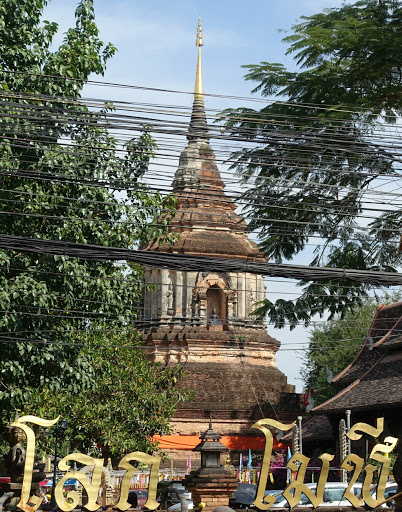 As I walked around the wall today, I passed many familiar things, including all five gates and the four corners. I also passed by one of my favorite temples, Wat Lok Moli, near the northwest corner (Hua Lin corner) of the wall, just outside the moat. It is said that King Mengrai had the chedi built to interr the remains of his family. Here is a picture of that old chedi from across the busy perimeter road and through the ever-present wires. I’ll visit the temple grounds soon and get more pictures (not through the wires).
Wat Lok Moli is also unusual in that the main viharn (worship hall) opens to the south, rather than to the east to greet the rising sun. I have not yet learned the reason why this is – almost all the viharns at almost all temples open to the east. I have visited many temples here and in Bangkok, and the viharns all open to the east with two exceptions, both in Chiang Mai: Wat Lok Moli, where the viharn opens to the south, and Wat Srisupan (the Silver Temple) where both the viharn and the ubosot open to the north.
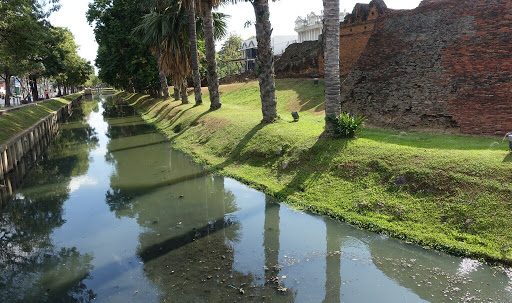
I was walking counter clockwise today, and after seeing Wat Lok Moli, I came to Hua Lin Corner, the northwest corner of the wall/moat. This is where the water in the moat came in from a nearby spring (I’m not sure how it works today, as that corner is home to an extremely busy intersection). This is a view from the corner looking east showing part of the wall at the corner, and the moat.
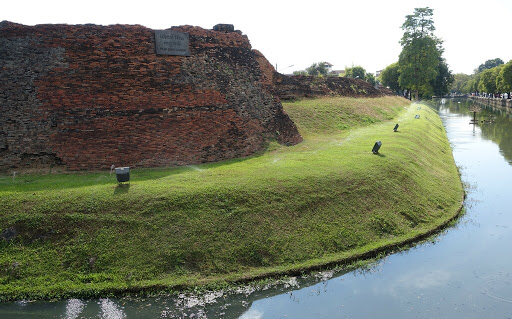
This is a view from the same Hua Lin corner, looking south. If it were a close-up of the sign, it says in Thai and English “Hua Lin Corner.”
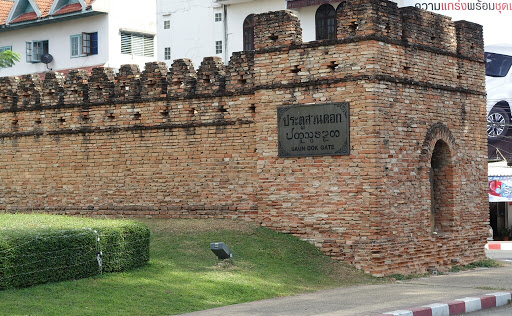
Walking further south along the moat, I came upon the gate on the east side, Suan Dok Gate. At one time, the fields to the east of the old city were the king’s flower gardens. Suan Dok means “flower garden,” so Suan Dok Gate at one time opened into the flower garden area. Now the road leading due east (Suthep Road) from Suan Dok Gate is the home of a few large teaching hospitals associated with Chiang Mai University farther out the same road. Wat Suan Dok is also out the same road about a kilometer, and I’ll walk out to Wat Suan Dok soon; it is one of my favorite temples (I have a number of favorites).
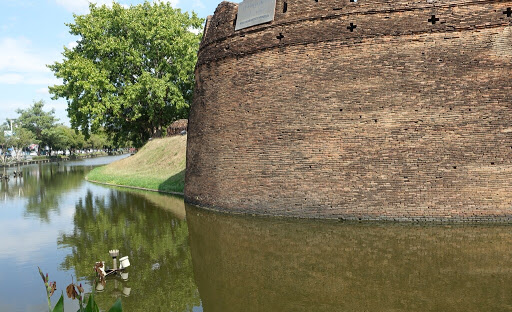
At the southwest corner is Khu Rueng corner.
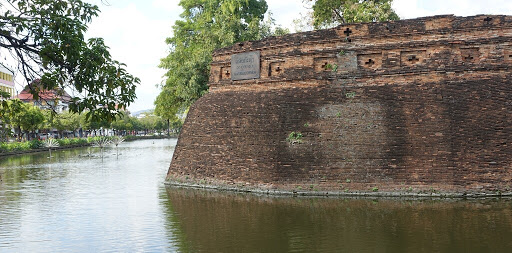
And finally, at the southeast corner is Katam Corner, where the water left the moat and fishermen caught fish as the water flowed into a natural creek. A katam is a fishtrap made of bamboo, thus the name Katam Corner.
A good first day walking around the wall & moat in Chiang Mai. The four mile walk took over two hours, but I stopped frequently and had traffic to contend with at all the places the roads go over the moat. As I get accustomed to the traffic flow, and if I do not stop so often, I can walk this much faster … but it is not a race, and it is hot in the afternoons, so why rush, after all I am in Chiang Mai. And I am enjoying it.
Next: Walking Around the Wall Again

 James the Intrepid Pilgrim
This brings back such fond memories. Love reading your blog. Happy new year to you.
LikeLike