Thursday, 22 January 2015 A Silk Factory and A Textile Exhibition
My Thai friend Jo picked me up at 3-Sis at 9:30 and we were off to the Samkampaeng area east of the old city to the Jolie Femme Thai Silk Factory.
The making of silk has a long history in Thailand. My understanding is that the making of silk in northern Thailand had dissipated in the twentieth century. After the war in the late 1940s, American Jim Thompson believed there to be a market for Thai silk, and is credited with revitalizing the craft and developing the Thai silk industry. Over the next few decades as the market abroad grew, the craft and the artistry grew, especially in northern Thailand, where the conditions are better for the silk worm propagation and growth.
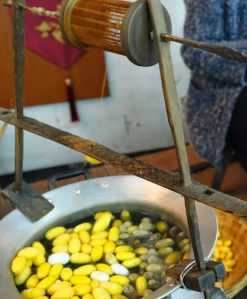
Silk works start their life feeding on a steady diet of mulberry leaves for the first year. Then they form a yellow cocoon around them. This cocoon is placed with many others in a vat of almost-boiling water, and the threads from many cocoons are combined to form one silk thread. It is not clearly visible in the photo (it is even difficult to see in person), but threads from many of the cocoons in the water are pulled up and combine through the hole in the metal cross piece, and then wind around the spool at the top as a single thread.
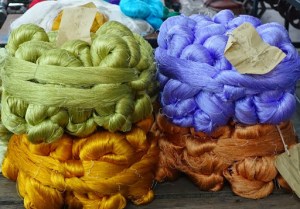
This raw silk is then washed with shampoo to soften it, dyed with natural dyes, and becomes soft silk thread, ready to be transferred to spools for the weavers.
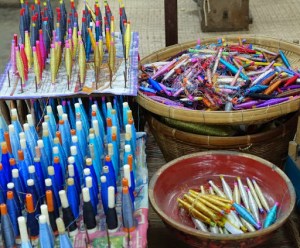
Spools of silk thread being prepared for weaving.
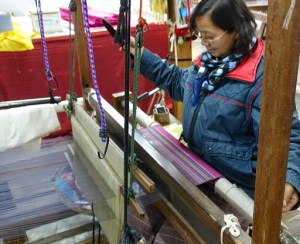
At Jolie Femme Thai Silk, all of the silk fabric is woven by hand. There are about 20 or more weavers working, impressively fast.
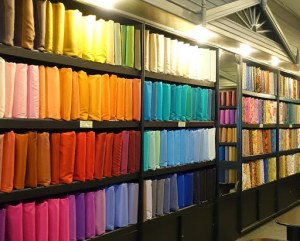
They have a vast supply of all colors of silk fabric that can be purchased in bulk. And they also sell pre-made silk clothing and a variety of silk goods.
The Textile Exhibition
After lunch at a very nice, remote restaurant, Jo and I made our way to Payap University to have a look at a textile exhibition that was part of the ASEAN Traditional Textile Symposium.
[ASEAN is Association of South East Asian Nations: Indonesia, Thailand, Malaysia, Singapore, The Philippines, Vietnam, Myanmar, Brunei, Cambodia, and Laos.]
The symposium was opened by the Royal Princess, and has been taking place bi-annually with each member country hosting. The symposium presents research of the history of textiles in ASEAN nations, the customs of manufacturing, and the conservation of traditional textiles from the nations. The purpose is to enhance and conserve the textiles of ASEAN nations, improve or learn new techniques to be able to produce textiles of quality and quantity to expand markets for ASEAN cloth in the world market. The exhibition was a small part of the symposium, and would only be in place for about five days.
The textile exhibition was mostly historic clothing from royalty in Myanmar (Burma), Northerm Thailand (formerly Lanna), Laos, and Vietnam from the eighteenth and nineteenth centuries. Almost none of the signs had English translations, so it was nice to be there with Jo for some interpretation.
I was not sure what to expect, and found the display to be quite impressive. And given the exhibition’s very limited time, I am very glad I heard of it and got to see it.

Some of the garments, having been made for royalty, had beads and other decorations woven into the fabric. This is very hard to see, even close up in person, but some of the beads and other decorations were not sewn on, but woven into the cloth.
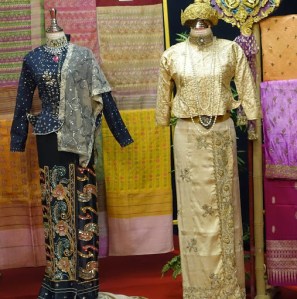
More clothing for royalty. I believe these to be from Burma.
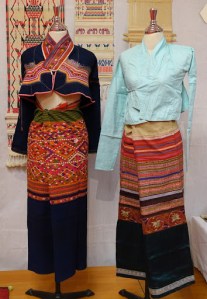
Still more royal clothing. The colors are quite vibrant, and after well more than 100 years are bright and clear.
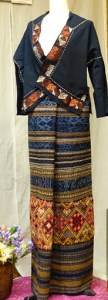
This is from Vietnam. The blues are quite bold and deep.

Jo and me pretending to be weaving cotton. The ladies at the entrance seemed excited to have a Western foreigner (me) at the exhibit, as almost all of their guests were part of the symposium and thus Asian, or local Thais. So they eagerly offered to take pictures with my camera. It was fun.
The knowledge of this exhibit was almost a surprise, and I am very glad I found out about it and had a chance to see it. I am also happy to learn that the symposium is ongoing, studying the history of fabrics in SE Asia and working to preserve techniques and move the fabric crafts forward.
The rest of the day was without pictures. I walked out to Kad Suan Kaew (a shopping center a couple hundred meters outside Hau Lin Corner, the NW corner of the wall). The same foot massage ladies that I see at the Sunday Night Market are set up at Kad Suan Kaew on Thursday and Friday, so I got my last foot massage with Nam. As usual, she had a big smile for me, but I did not have my camera.
I walked back along the moat and wall, went to Jane’s Kitchen for a small dinner. They were closing early to attend a party for a family member who had just graduated from Chiang Mai University.
And to end the day, I attended my last meeting of the Green Papaya Sangha meditation group at the Yoga Tree.
It was another of many very good days in Chiang Mai!
Next: Wiang Kum Kang and the Temple Ruins

 James the Intrepid Pilgrim