Tuesday, January 6, 2015 – Outside the Moat to Wat Mahawan and Wat Chetawan
I walked outside the old city (aka outside the wall or outside the moat) down Tha Phae Road to see what has changed. Many things change, and many stay the same, just like in the U.S. I stopped at Wat Mahawan, a temple of unknown origin date, the viharn (worship hall) and ubosot (ordaining hall) were built in the 1860s. The chedi in the back is much, much older, and in a detailed Burmese style. both Wat Mahawan and Wat Chetawan were to have been originally built by Burmese teak merchants. This is supported by the Burmese-style in some of the details of the chedi and the buildings.
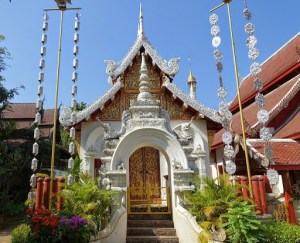
The ornately detailed ubosot ordaining hall at Wat Mahawan. To the right is the roof of the main viharn, in the Lanna style, with a multi-layer, steeply pitched roof.
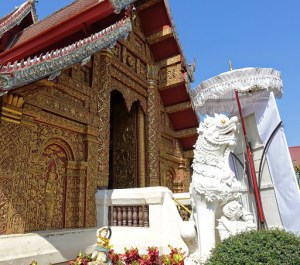
One of the giant cinthe guarding the entrance to the viharn. The cinthe is a mythological lion-dog creature sometimes with a human face, most often seen in pairs, protecting the entrance to a viharn or chedi.
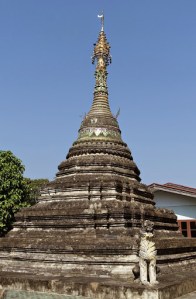
The chedi at Wat Mahawan, in a detailed Burmese style, guarded at the corners by smaller cinthes.
Practically across the main street from Wat Mahawan is Wat Chetawan. A very different temple grounds — there are always many cars parked here, but it is very quiet, and while I always see monks at Wat Mahawan, Wat Chetawan is almost always deserted.
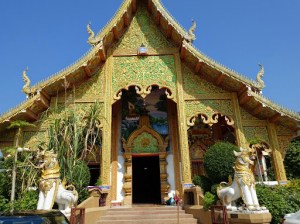
The main viharn at Wat Chetawan.As is common in the Burmese style, the entrance is guarded by to large cinthes. The roof is the multi-layer, steeply-pitched Lanna style. This was built in the mid-1800s, although there is evidence that a temple existed here much longer.
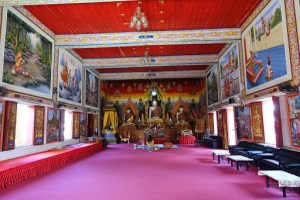
The inside of the viharn is painted unlike any temple I have visited. I am just not sure what to make of this. The coloring is very modern-looking, and the large paintings not as rich and detailed as I have seen in many temples. They are obviously the same style, suggesting that they were done deliberately this way.
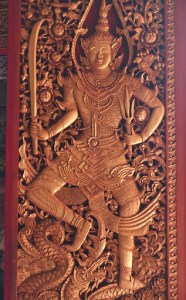
One of the carved doors to the main viharn depicting a being that appears similar to thewada (angels), but is carrying a sword and a three-pronged knife, so this is some kind of a warrior.
I intended to walk down to Katum Corner (the SE corner of the wall/moat) and noticed on the inner-moat road, Moon Muang Road, a temple I had never stopped by to see. The temple name is Wat Sai Moon Muang and while small, has two nicely adorned small viharn.
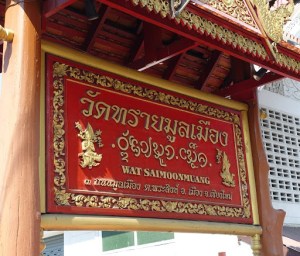
The entrance sign at Wat Sai Moon Muang (there are no spaces in a Thai sentence or phase, so it is natural to omit the spaces in the translation, as well).
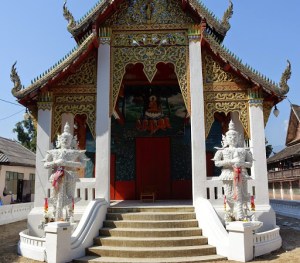
This small viharn is guarded by two smaller sized giants called a Yak. There are Yaks in Bangkok’s main airport that are 8 meters high guarding the check-in areas, so these two-meter Yaks are smaller..
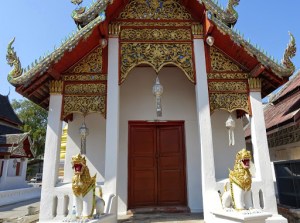
Another small viharn guarded by two ornately adorned Cinthes.
Other than some construction workers, nobody was at Wat Sai Moon Muang, and I could fing almost nothing about it in the internet. I may return another day to learn more.
I completed my walk by rounding Katum Corner, then along the wall/moat and into the old city at Chiang Mai Gate.
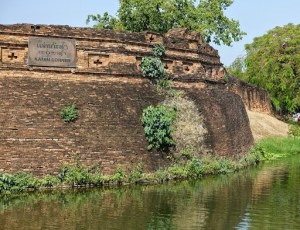
Katum Corner, SE Corner of the Wall/Moat
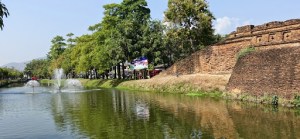
Along the South Wall/Moat
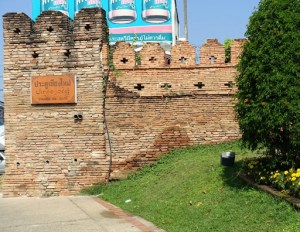
Chiang Mai Gate on the South of the Wall
Next: A low-key day and American dinner

 James the Intrepid Pilgrim