January 24, 2014 Friday
Linda was off for most of the day at a Thai cooking school where they take you to a market, shop for fresh ingredients, then teach you to cook several dishes. There are many of these in Chiang Mai, and it is an all-day event (or most of the day). So I was basically on my own. Lucia and Jo had come into Chiang Mai from Mae Rim (where Jo lives), for a massage, and called me after to see about lunch. We met at Wat Chiang Man (Kin Mengrai’s first temple in the inner city), and walked to Blue Diamond for lunch. After lunch, Jo suggested that we go off to an old Lanna-style temple outside the main city.
Wat Ton Kien
Wat Ton Kien, also sometimes spelled in English Wat Thon Khwen, is also called Wat Inthrawat. It is a smaller temple in the rural area 10 or more km southwest of the old Chiang Mai city, close to Hang Dong. This is a very rural area, and quite quiet, the mood is tranquil. Because this temple is so infrequently visited by tourists, there is little information available about it in English, but I learned that it was built in the mid-1800s, so while it looks old due to the aging on the wood, it is newer than many of the temples I have visited. Wat Ton Kien is one of the few remaining wooden temples in their original state in the Chiang Mai province. The temple is now under the care of the Thai Fine Arts Department. Some renovations have been carried out aiming to leave the original structures intact as much as possible. I took many pictures, a few of which are shown here.
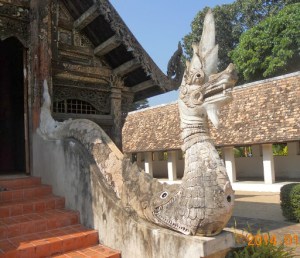
This is an old temple, in the old Lanna style. All of the outside is wood, including the nicely carved naga/dragon stairway banisters. In most other temples, these are in ceramic tile.
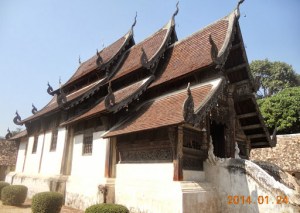
The main viharn (worship or prayer hall) at Wat Ton Kien. One giveaway of the Lanna style is the roof and the adornments on the roof. all done on carved wood on this structure.
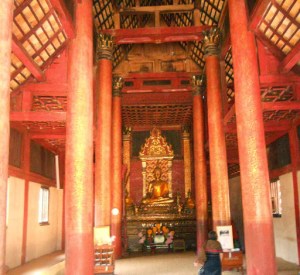
Inside the viharn. Almost all in teak, and it is quite stunning.
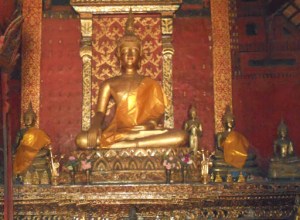
A closer view of the Buddha image in the viharn. Nothing particularly unusual or even special, but a very nice example of what I think of as a neighborhood temple that has been in daily use for well over a hundred years.
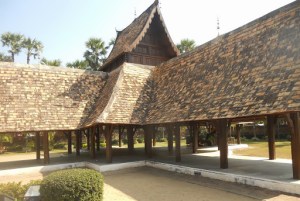
Theviharn is surrounded on three sides by this covered walkway that leads to a prayer area.
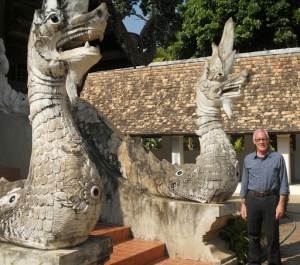
And here I am at the entrance to the viharn.
Wat Lok Molee
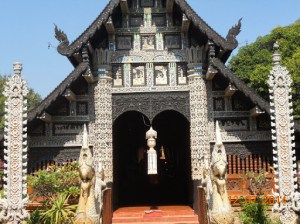
After a visit to Wat Ton Kien, Jo, Lucia, and I headed to Wat Lok Molee, one of my favorite temples at the north side of the moat. Wat Lok Molee never fails to impress. I read a little more of the detailed sign, and learned that King Mengrai built this temple to house the remains of part of his family. This suggests that the temple itself dates back to the early 1300s, making it older than the large chedi at Wat Chedi Luang.
After the visit to Wat Lok Molee, Lucia and Jo headed back to Mae Rim, I walked back to 3-Sis. Later I met Linda and we went for dinner at or favorite Italian restaurant, Boutique della Pasta and Linda told me all about her day at the Thai cooking school.

 James the Intrepid Pilgrim