January 20, 2014 Monday Part 2
After the Bhuping Palace Gardens, Ms. Ying drove us partway down the mountain the Wat Phra That Doi Suthep. This temple is often called simply Doi Suthep, and pretty much everyone knows to which temple you are referring. Doi means Mountain or Mount, and Suthep is the name of the mountain. Wat Phra That is the name of the temple that is on Mount Suthep.
Wat Phra That Doi Suthep
According to legend, a monk named Sumanathera ventured to Pang Cha and found a bone, which many claim was Buddha’s shoulder bone. The relic displayed magical powers; it glowed, it was able to vanish, it could move itself and replicate itself. King Nu Naone of the Lanna Kingdom heard of the relic and in 1368 with Sumanathera took the relic to what is now Lamphun, in northern Thailand (Lamphun is about 25 miles south of Chiang Mai). The relic apparently split in two, one piece was the same size, the other was smaller than the original. The smaller piece of the relic was enshrined at a temple in Suandok, now called Wat Suan Dok (a favorite temple of mine). The larger piece was placed on the back of a white elephant which was released in the jungle. The elephant climbed up Doi Suthep, at the time called Doi Aoy Chang (Sugar Elephant Mountain), trumpeted three times before dying at the site. It was interpreted as a sign and King Nu Naone ordered the construction of a temple at the site. This is a very sacred temple to the Bhuddist people of Thailand.
I have been to Wat Phra That Doi Suthep several times in the past, and have taken many pictures. Every time I have made the journey up the winding road, the temple does not disappoint. It is a very winding road to get there, and in the back of a Red Truck add to the constant turning the diesel fumes, and one could easily become carsick. I did not take as many pictures this time, as the temple is very similar to what I remember. But I will post a few here.
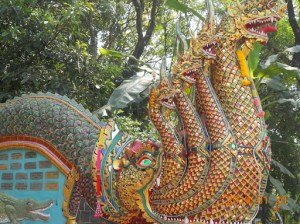
This is the end of the famous Naga Staircase with the seven-headed dragon coming out of the serpent’s mouth. The whole stairway is 307 steps, but starts lower than this point. From here, there are about 250 steps to get to the top where the temple is located.

Here is part of the naga bannister looking up part of the stairway from the dragon. The ceramic tiles making up the naga bannister are over 500 years old and still quite beautiful.
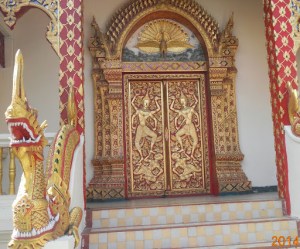
At the top, there are a few viharn (worship or prayer hall) outside the center section. I have always enjoyed the four-armed, dancing thewada (angels) depicted on the doors of this viharn.
The organization of Wat Phra That Doi Suthep is different than most temples. There is a square structure, almost like a viharn, surrounding the large chedi that houses the relic. In the square structure around the chedi are several viharn or almost rooms in which one can worship or pray.
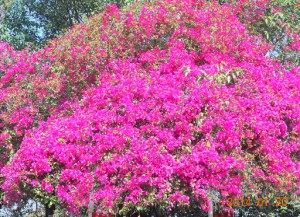 In the area outside the square viharn there are a few smaller viharn, and an area to look out over all of Chiang Mai. There are three very large bougainvillea bushes, quite like what we see in Southern California.
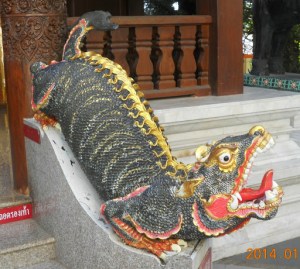
One of the smaller outside viharn is guarded by two Mom (pronounced almost like moam) serpents. A Mom is a northern Thai mythological creature, a guardian of the temple, tied to Puchoona, the angel of cloud and rain. Puchoona angel is an entourage of of Waroon, the god of rain. So the Mom not only guard the temple, but may also help bring the rain.
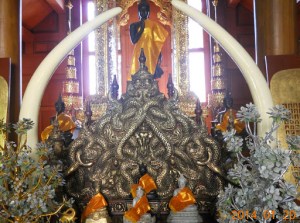
Inside the small viharn guarded by the Mom is this odd, multi-snake figure showcased by these two very large elephant tusks. This is something of which I just do not know the meaning. I have seen it a very few places, so information is available, just not to me yet.
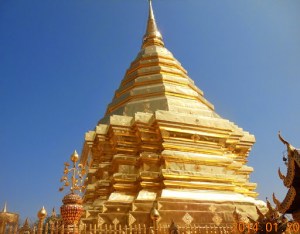
Inside the actual temple is the large chedi housing the relic. It is stunning.
Thai people hold a lotus flower and circle the base seven times reciting prayers. There are always people doing this ritual every time I have been to Wat Phra That Doi Suthep.

The very old, possible bronze Buddha image in one of the viharn areas around the main chedi.

Another of the Buddha images, I have been told this one is a glass replica of the Emerald Buddha (emerald referring to its color, not the stone). The Emerald Buddha is carved from a single jade stone, about 66 cm tall (26 inches) and now resides in Wat Phra Kaew on the grounds of the Grand Palace in Bangkok.
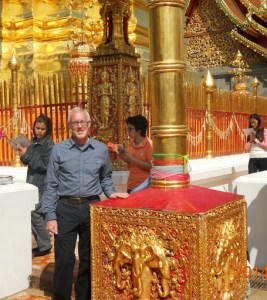
And here I am at the corner of the large chedi. The detail is not as good as I hoped in this picture, but behind me is a corner with very nice thewada carvings on the sides. Also visible are people walking around the chedi and reciting their prayers. Not all are carrying a lotus flower.
Next: Up Doi Suthep – Part 3 Wat Palad

 James the Intrepid Pilgrim