January 18, 2014 Saturday
After a fairly aggressive schedule yesterday showing Linda some of my favorite temples in the old city, today we ventured outside the old city to look at Wat U-Mong, and Wat Jet Yod. I arranged with a Red Truck driver to take us to both, wait for us at both locations, and then take us back to Wat Chedi Luang (across the street from the 3-Sis) – probably a three hour tour (as the Gilligan’s Island song says).
Wat U-Mong
Wat U-Mong is to the west of the old city about two kilometers, and basically south of Wat Suan Dok about one kilometer. I walked out to Wat U-Mong once last year, but it is a long walk, and part of the road is dangerous because (1) it is twisty, and drivers cannot see walkers well or at all, (2) the drivers on that road are not expecting to see walkers, and (3) the drivers on that road drive too fast. I’ll not walk that road again. Wat U-Mong is a an old temple (as are many), built by King Mengrai in the last few years of the 13th century, about 1296 or 1297 AD.
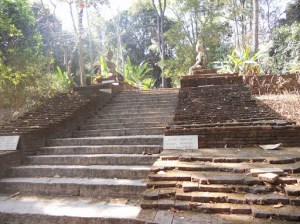
On arrival, it appears as if this is just a temple in the forest. One walks up some very old brick stairs, past two stone sentries to the landing. At many temples, the next thing you would see would be the viharn (worship hall).
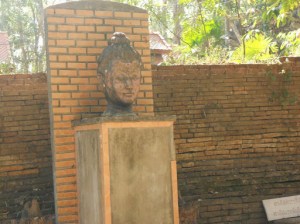
At the top of the stairs and just over to the left at Wat U-Mong is this head, with the only sign in Thai. I suspect this may be a depiction of King Mengrai.
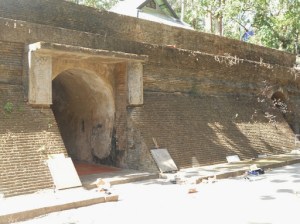
Looking forward, instead of a viharn there are three cave entrances in the side of a brick-covered hill. And this is the viharn. The caves or tunnels were supposedly built by the King and painted with bush scenes so they could keep a famous but mentally deranged monk within the grounds of the monastery as he had a habit of just wandering off into the bush for days on end.
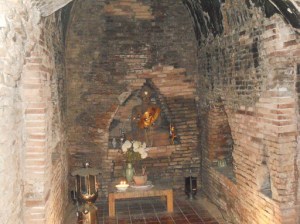
The caves basically are the viharn. At the end of each cave or offshoot, are these fairly small, almost personal worship areas.
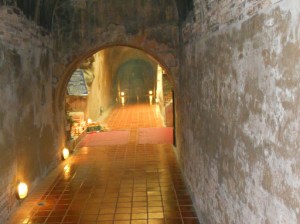
Looking down one of the caves, you can see a junction, a worship area to the left, another on the right, and another forward. I have been told that the uneven color on the cave walls are the last remaining evidence of the paintings that once covered the walls.
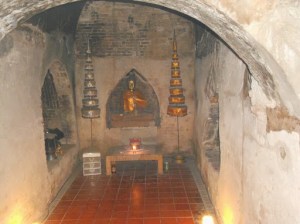
Here is another of the worship areas at the end of one of the caves. They are all a little different.
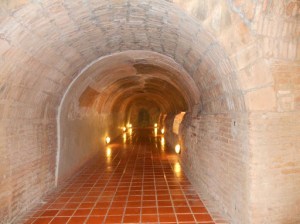
Down the hall is yet another worship area. At one time, the walls had paintings, but almost all are so faded that they are only a memory.
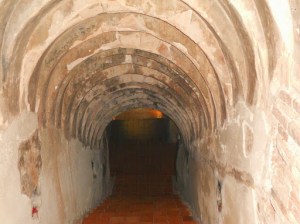
There is a stairway in the caves towards the back. notice how the stairs are echoed in the ceiling.
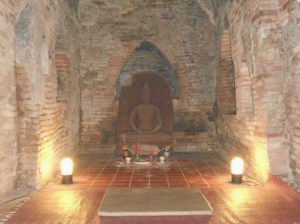
And one of the last of the worship areas. There are about ten altogether, all a little different, and all show signs of being used today with candles still burning, or incense burning. While Wat U-Mong is old and quite different than the other temples, it is in daily use.
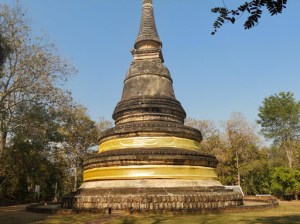 Then, at the top of the caves, over to the left, is this large chedi. Old, tall, reverent, and dignified. This chedi, not unlike others, has a great personality. You can almost feel a powerful and good energy when you stand near this chedi at Wat U-Mong.
After a little time at Wat U-Mong, we headed on a journey to Wat Jet Yod, about a half-hour drive.
Wat Jet Yod
Wat Jet Yod translated: Wat is temple grounds, Jet (or Jed) is seven, and Yod is either spires or places. The main old viharn at Wat Jet Yod has seven spires on the roof. Wat Jet Yod dates back to the mid-15th century, and was built in 1455 to be the site of the Eighth World Buddhist council in 1477 at which the Buddhist canons and teachings were revised. I read that nobody seems to know the results of the council, but the temple remains. Wat Jet Yod is mostly older buildings, with one newer viharn that is always open. I have never seen the old viharn with the doors open until today.
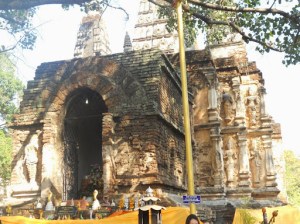
This is the back of the oldest viharn at Wat Jet Yod. There are always Thai people here doing their prayers.
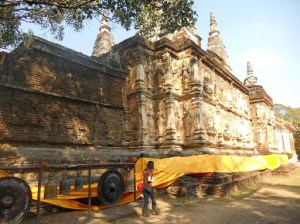
Walking around to the south, past the large bells (the disk-like ones are called gongs, and they do emit a low-pitched very beautiful g-o-n-g sound).
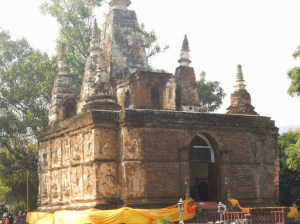
From what I presume is the front, the seven spires or chedis on the top of the viharn are visible. Actually, in this picture, only six of the seven are visible.
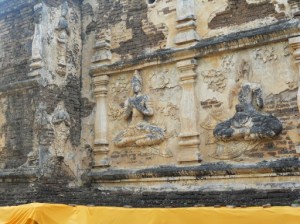
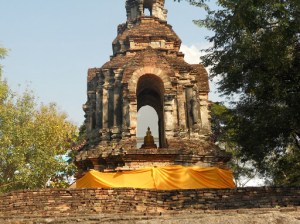
On the other side one can see these old thewada carvings in the stucco on the side of the viharn. Thewada are angelic beings that live in the heavenly realm, or similar to angels in Christianity. Thewada are depicted similarly, but differently and very artistically at all temples. They are commonly on the sides of the viharn, and often adorn the doors of the viharn.
On of the several chedis at Wat Jet Yod. I have always found this one to be quite beautiful.
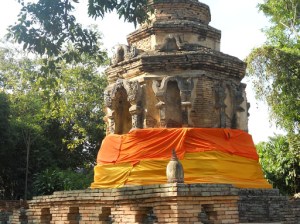
Another of the chedis at Wat Jet Yod. there is no indication of whose remains are entombed in these old chedis.
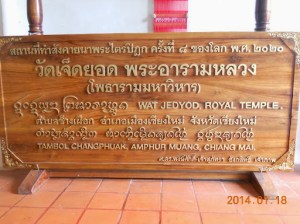
This is just inside the old viharn doors. A sign announcing Wat Jet Yod, or here spelled Wat Jedyod.
In Thai, a sentence contains no spaces between words, which is why Thai writing seems to have v-e-r-y long words; those very long words are actually sentences. So it is natural for Thais to put words together, even when the translation would be two words. A common example is that the city name Chiang Mai is often spelled in English as Chiangmai.
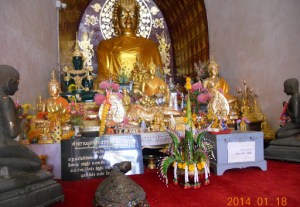
A picture inside the old viharn. I have been to Wat Jet Yod about four previous times, but this is the first time I have seen inside the old viharn.
Quite beautiful.
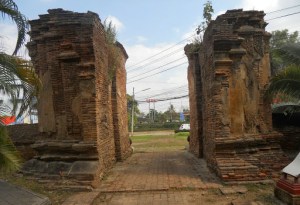
I believe this was the old original entrance to the temple grounds. The grounds are quite spacious, covering close to 10 acres.
Next: an afternoon visit to Wat Phra Singh

 James the Intrepid Pilgrim