January 1, 2014 – New Year’s Day
I woke to a new day and a new year. The day looks to be stunning, as are most days here in Chiang Mai. I have no specific plan today. My back is sometimes better and sometimes not, so I will pass on yoga today and for a few days, except some general stretching in my room.
I saw an interesting sign:
Coffee should be black as hell, strong as death, and sweet as love.
This was said to be a Turkish proverb. And while it may be more aligned with the hard-core coffee drinkers, I am loving the Thai coffee here, a coffee that we do not have in the U.S. The Thai coffee is not as black as hell and as strong as death (whatever exactly that means), but it has a good flavor, and I like it enough to use much less milk and sugar than what I use in the U.S. (I know, I’m definitely not a coffee-purist.)
Breakfast
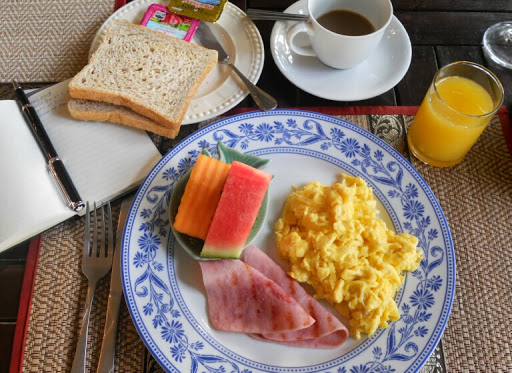
Breakfast sometimes looks like I am at home, coffee, orange juice, eggs, ham, some fruit, and toast (plus my ever-present notebook).
The Wall
I walked the entire circumference of the wall/moat today. Chiang Mai was originally a walled city. And, in addition to the wall, they added a moat outside the wall to help protect the city from intruders. The square formed by the wall/moat is about 1.5 km on a side, making the circumferance 6 km or about 4 miles.The moat still exists all around except at the Tha Phae gate area, but there is much less of the wall still in existence. The moat at one time was three or fours times wider than today; in the late 19th or early 20th century, part of the moat was filled in to make the outer road,and this may have occurred more than one time. In some places, the wall and particularly at the corners, there were restorations made in the late 1800s or early 1900s so these areas still have an old character to them. At areas like Tha Phae Gate and Suan Dok Gate, I read that restorations took place in the 1960s, and the look is much newer. Here are a few photos on this of my many walks around the wall/moat:
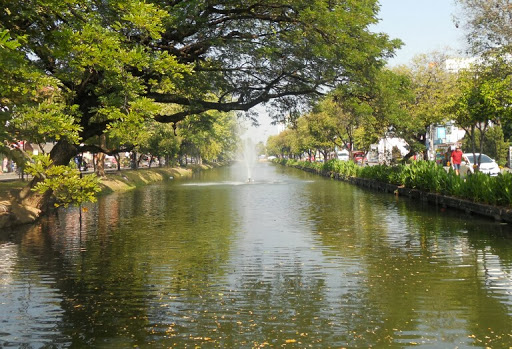
This is a view of the moat from the southeast corner, looking north. No wall exists on either side of the moat here.
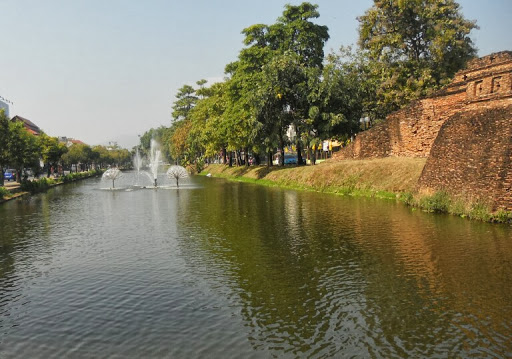
This is a part of the wall at the southeast corner, called Katam Corner, and looking west along the south expanse of the moat. The word Katam has a meaning similar to fish trap or animal trap. Water entered the moat at the north west corner (Hua Lin Corner), flowed east along the north side and south along the east side, and also flowed south along the west side and then east along the south side. The water met at the southeast corner and pooled, and many fishermen trapped fish there. Thus the name Katam Corner.
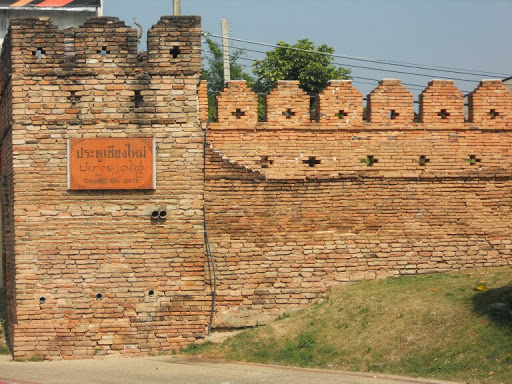
Part of Chiang Mai Gate, the major of the two gates on the south side of the wall. This restoration was made in the late 1800s or early 1900s (according to stories).
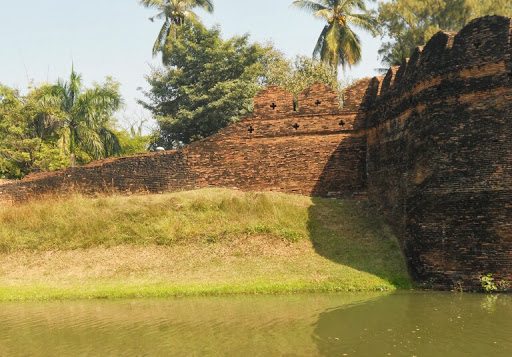
Part of the wall at the southwest corner, Ku Huang Corner.
There are more pictures of the wall and moat from the posting I made last year on Picasa at https://plus.google.com/photos/114204560042394240043/albums/5854307855322296241
Dinner at Kanjana
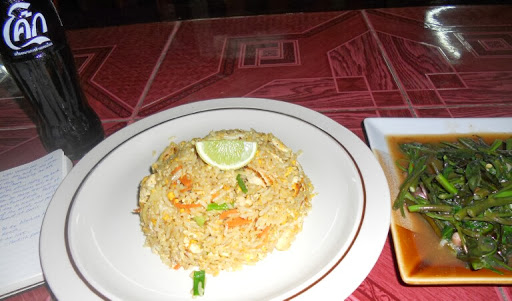
To start the new year on a good note, I had dinner at Kanjana again. No pumpkin curry tonight, a simple meal of fried rice with pineapple and chicken, a plate of morning glory, and a Coke (and there is my notebook).
Next: At the Oasis Spa

 James the Intrepid Pilgrim