After a mad dash to the Bangkok Hua Lamphong rail station, and an almost hour wait, I finally boarded the train to Chiang Mai. Here is the Hua Lamphong Rail station, originally built in 1916:

The State Railway of Thailand (SRT) train to Chiang Mai covers what is known as the “Northern Line”. The daytime Bangkok-to-Chiang Mai “Express”, trains 3, 9, and 12, uses a diesel-rail-car powered short train consisting of a power car and three coaches. The “express” covers 750 km (465 miles) in 12 hours with 7 stops. The seats are not terrible, but after 12 hours, not comfortable, either.
An historical item of note: The State Railway of Thailand has over 4000 km (2500 miles) of tracks, all of it meter gauge (1 meter = 39 1/2 inches). So-called “Standard” gauge rail used in most places in the world is 56 1/2 inches. The SRT, previously known as the Royal State Railways of Siam (RSR) dates back to 1890, and was originally built as standard gauge, but converted to meter gauge between 1920 and 1930.
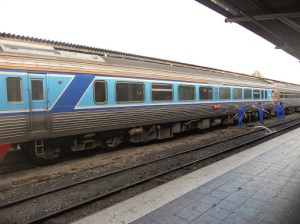
The train left Bangkok on time at 8:30 AM. The initial 20 miles getting out of Bangkok was very, very slow, mostly because of a massive construction project alongside the tracks that appears to be building concrete trestles to elevate the rails off ground and street level. The construction extends for almost 15 miles or more. By 10:00 AM the first rice paddies appeared, and we were moving faster, perhaps 50-60 miles per hour, slowing only for small communities and what appeared to be commuter rail stations along the route. The ride is not completely smooth, but not terrible, either. This is obviously jointed rail as opposed to CWR (continuously welded rail). I had thought that upgrading of the SRT northern line was to put CWR in place, but that is not yet evident.
We were supposed to be in Ayutthaya at at 9:45 but because of the slow running to get out of the Bangkok area, we are almost an hour behind schedule. Ayutthaya was the capital of Siam from 1350 until 1767, and this is the largest station since we left Bangkok. Most of the other stations along the way were what could be termed suburban stations, likely used for commuter trains to and from Bangkok.
 After Ayutthaya, the rice paddies are everywhere, almost as far as one can see on both sides of the train. I expected to see a lot of rice farming, but there is far, far more than I had imagined. Rice is a MAJOR crop here.
North of Lop Buri, the track is smoother and quieter, and likely CWR has been installed here. We are moving very fast now. Also, we are seeing other crops occasionally, corn. low-lying vegetables, and a few large plots of sunflowers (that went by too fast for me to get a picture).
As we move higher in elevation, there are still rice paddies, but not as many. We see more of the other crops, banana trees, and what appears to be a type of sugar cane. By 1:00, we entered another long flat area, and the rice paddies are all over and quite expansive. Nearing the half-way point at Phitsanulok, the rail is not so smooth. There is still rice as far as one can see. It is almost boring, and on the other hand fascinating. The land before and after Phitsanulok is filled with rice paddies, they just go on and on. Quite amazing. As I said, it is clear that rice is a MAJOR crop.
4:00 PM it is obvious that we are into the mountains. These are jungle covered mountains, but every visible flat spot hosts a rice paddy. More of the trees are stocky and broad, and there are more clumps of banana trees seen. More and more, though, the jungle is quite dense with vines growing onto and climbing many trees. I could easily imaging tigers living in this jungle. Occasionally, stands of bamboo can be seen, almost mixed in with the dense trees, bushes, and vines. A real jungle. In some clearings, there are expanses of tall grasses.
All along the route are occasional neat piles of rails and concrete ties. Much upgrading of the line is underway. Where work has been done, are piles of wooden ties that are quite deteriorated. The replacement of these was well past due.
6:00 PM too dark to see outside now. It is very cold in the train. Probably the air conditioning is either on or off, and if off, it would be too hot. But I am cold. I am hoping we arrive on time.
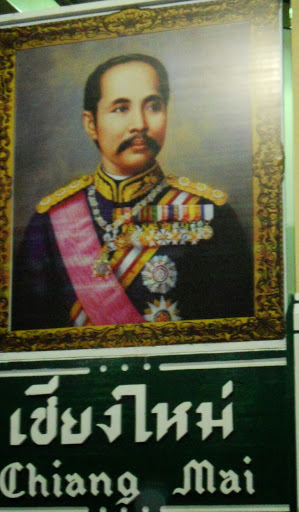
9:30 PM we arrived an hour late.
The sign shown in the picture is quite prominent in the Chiang Mai rail station. I thought that this might be King Mengrai, the founder of Chiang Mai, but the gentleman’s look is too modern – King Mengrai built Chiang Mai in the late 1200s, and this look is likely from the 19th century. I learned that this is King Rama V, or King Chulalongkorn (his full name was Phra Bat Somdet Phra Poraminthra Maha Chulalongkorn Phra Chunla Chom Klao Chao Yu Hua). King Rama V, crowned king of Siam in 1873, is said to be one of the greatest kings of Siam. His reign was characterized by the modernization of Siam, immense government and social reforms, and territorial cessions to the British Empire and French Indochina. Siam was threatened by Western expansionism, Chulalongkorn, through his policies and acts, managed to save Siam from being colonized.
I have arrived.
I got a ride in a Red Truck to the 3-Sis Guest House. It is colder in Chiang Mai at night than I have ever experienced — only about 52 degrees. And this is in a place where homes have no heaters. The Thai people are layering.

 James the Intrepid Pilgrim